
The McKinsey 7S model is a tool for examining a company’s organisational design and the relationships between its parts. It was developed at McKinsey & Company.
The model covers seven internal elements: strategy, structure, systems, shared values, style, staff and skills. They are interconnected: when one element changes, it is important to consider the effect on the others.
Strategy, structure and systems are described as the “hard” elements: they are easier to identify and analyse. The remaining “soft” elements are harder to manage directly, yet they underpin the organisation and can support a lasting competitive advantage.
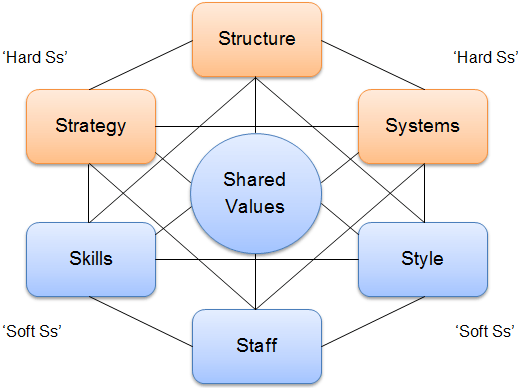
How to examine the seven elements
Strategy
A plan for achieving a sustainable competitive advantage. A strategy should be well founded, clearly articulated and connected to the company’s vision, mission and values. It also needs to align with the other elements of the model.
- Does the organisation have a clear view of what it wants to achieve and how?
- Do people share an understanding of its strategic and tactical goals?
- How does the company adapt to changes in the market?
Structure
The way departments, responsibilities and reporting relationships are organised. Structure also shapes how different parts of the company work together.
- Is there confusion about who does what?
- Are individual goals and responsibilities clear?
- Does communication work well within and across departments?
Systems
The processes and procedures through which the organisation operates each day: planning, sharing information, making decisions and tracking results. Consider whether they support the chosen strategy and structure.
Style
How leaders manage the company: their actions, interactions and the example they set for others.
- Are there management subcultures whose approaches conflict?
- How do employees respond to the leadership style?
- What behaviours and results do leaders reward?
Staff
The people and staffing levels the organisation needs, and how it recruits, trains, motivates and rewards them.
- Is recruitment approached consistently?
- Can people see opportunities to develop within the company?
- Are the tools for motivation and team development effective?
Skills
The team’s skills, competencies and capabilities. During organisational change, consider which ones are needed to support the new strategy or structure.
- Does the team have the skills it needs to work effectively?
- Which capabilities need to develop for the next stage?
Shared values
The norms and principles that guide people’s behaviour and decisions. Shared values sit at the centre of the model, connecting all its elements.
- What are the company’s mission and vision?
- Is there a shared understanding of how work and collaboration should happen?
- How do values show up in daily work?
When to use the model
- During organisational change.
- When implementing a new strategy.
- To explore how different parts of the company may need to evolve.
- During a merger.
How to work with the model
- Identify which elements are out of alignment.
- Describe the desired organisational design.
- Decide where changes are needed and what they should involve.
- Implement the changes.
- Review all seven elements regularly.
Questions to start with
- Are the different parts of our organisation aligned?
- Which elements need closer examination and change?
- What can we do today to begin?